

How Battery Capacity Affects Thruster Runtime

When choosing a battery for an electric water thruster, one of the most common questions is: how long will the battery last? The answer mainly depends on battery capacity and thruster output power. Of course, runtime is not absolute; it is also affected by external factors such as load, hull type, temperature, and more.
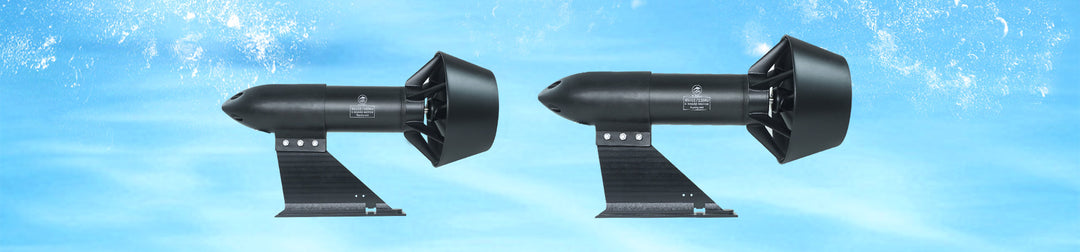
For a high-power system like the Flipsky Electric Thruster, understanding the relationship between watts, watt-hours, and runtime will help you choose a battery that meets your needs.
How to Calculate Thruster Runtime
Battery energy is usually measured in Wh (watt-hours). A simple theoretical formula is: Runtime (hours) = Battery capacity (Wh) ÷ Power consumption (W) Take the Flipsky 2800 Thruster as an example. Its rated power is 2800 W, and its maximum power can reach 4200 W. Its optional battery pack is rated at 50.4 V, 16.8 Ah, which is 846.72 Wh.
Using 846.72 Wh as an example:
| Thruster output power | Theoretical runtime |
| 2800W | ~18 minutes |
| 1000W | ~51 minutes |
| 500W | ~102minutes |
These figures are theoretical. In real-world scenarios, the motor will not always run at its full 2800 W rating due to various factors, so power use is dynamic during operation. In our actual tests, at full-throttle output, runtime lasted about half an hour. At a sustained 500 W output, runtime lasted about 90–120 minutes.
Actual runtime is also affected by many factors, such as motor efficiency, power losses, battery discharge limits, operating environment, load, and even the quality of the battery cells. Flipsky batteries use high-quality cells, so their capacity is more dependable.
Choosing Battery Capacity Based on How You Use It
No single battery specification fits all setups, and you do not always need a large battery. For casual cruising, pairing a low-power thruster, such as a 1200 W model, with a moderately sized battery gives you a lighter, easier-to-carry setup. For strong acceleration and high-intensity riding, 2800 W or 3700 W models require a battery with both sufficient capacity and sufficient continuous discharge capability. For long-distance riding, prioritize battery capacity. As long as you can accept the added weight and bulk, a high-capacity battery provides more energy reserve, thereby extending ride time.
A Simple Way to Estimate Battery Needs
Before buying a battery, ask yourself three questions:
- Which thruster am I using?
High-power thrusters usually consume more energy. - How long do I want to ride?
The longer the ride, the more battery energy is needed. - How intensively will I use the thruster?
Cruising at medium power consumes far less energy than continuously holding high throttle at full power.
For a more accurate estimate, refer to the following formula: Required battery energy ≈ Average power × Expected runtime
Then: Required capacity (Ah) ≈ Required energy (Wh) ÷ Battery voltage (V) Be sure to reserve some practical buffer capacity. Never plan to drain the battery completely.
For electric paddleboards, kayaks, and other watercraft, battery capacity should always be considered together with discharge capability, voltage compatibility, weight, and water resistance. Flipsky also recommends matching battery voltage and continuous current capability to the entire thruster system.
Therefore, choosing the right battery is not simply about buying the largest capacity. The goal is to find the right balance among power, runtime, weight, and real-world usability.
For more details, please review our official website and social channels.
https://flipsky.net/
https://www.youtube.com/c/FlipskyTech
https://www.instagram.com/flipsky_tech/
https://www.facebook.com/FlipskyTech



Leave a comment